
When Policies Are Not Enough: The Mediating Role of Science, Technology and Innovation between Triple Helix Conditions and Business Sustainability
Cuando las políticas no bastan: el papel mediador de la ciencia, la tecnología y la innovación entre las condiciones de la triple hélice y la sostenibilidad empresarial
Affiliations
- Antioquia Institute of Technology ROR https://ror.org/00s9vmn82
Abstract
The Triple Helix literature has documented in detail the institutional arrangements that link universities, industry, and government within innovation ecosystems. What remains empirically underspecified, and particularly so in emerging economies, is the mediating mechanism through which those same arrangements come to generate, or fail to generate, the real business sustainability at issue. It is precisely this gap that the present study sets out to address, developing and validating the STI-Triple Helix Mediation Model (MMSTI-TH), a model built from the data provided by 188 actors in the Science, Technology, and Innovation (STI) ecosystem of Medellín, Colombia, and estimated by means of seven convergent quantitative techniques applied in a non-experimental, cross-sectional design with non-probabilistic convenience-snowball sampling (N = 188). The central finding is that STI functions as a necessary total mediator, in the sense that the direct effect of Governance Policies on Sustainability does not reach statistical significance (β = −0.044, p = .691), whereas the effect that travels through STI proves both substantial and robust (β_ind = 0.588, 95% CI [0.396, 0.808]). The latent profile analysis, for its part, yielded two empirically distinct actor configurations, namely Connected Innovators (41.5%, n = 78) and Peripheral Skeptical Actors (58.5%, n = 110), a contrast that brings to light a systemic legitimacy deficit which is explained not by the design of the policies but by the gaps that appear in their implementation. The study proposes the MMSTI-TH as a foundation for a General Mediation Theory of Innovation Systems (GMTIS), presented as a preliminary framework with five testable propositions, four conditions of application, and a preliminary international contextual comparison with European, Asian, and Latin American innovation systems. The model is proposed as a replicable diagnostic instrument for STI ecosystems in the Global South.
La literatura sobre la triple hélice ha documentado en detalle los acuerdos institucionales que vinculan a universidades, industria y gobierno dentro de los ecosistemas de innovación. Sin embargo, lo que aún no se ha especificado empíricamente, especialmente en las economías emergentes, es el mecanismo causal mediante el cual dichos acuerdos generan, o no, la sostenibilidad empresarial real en cuestión. Es precisamente esta brecha la que el presente estudio se propone abordar, desarrollando y validando el Modelo de Mediación CTI-Triple Hélice, un modelo construido a partir de datos proporcionados por 188 actores del ecosistema de Ciencia, Tecnología e Innovación (CTI) de Medellín, Colombia, y estimado mediante siete técnicas cuantitativas convergentes. El hallazgo central es que la CTI funciona como un mediador total necesario, en el sentido de que el efecto directo de las políticas de gobernanza sobre la sostenibilidad no alcanza significación estadística (β = −0,044, p = .691), mientras que el efecto que se transmite a través de la CTI resulta sustancial y robusto (β_ind = 0,588, IC del 95 % [0,396, 0,808]). El análisis de perfiles latentes, por su parte, arrojó dos configuraciones de actores empíricamente distintas, a saber, Innovadores conectados (41,5 %, n = 78) y actores escépticos periféricos (58,5 %, n = 110), un contraste que pone de manifiesto un déficit de legitimidad sistémica que se explica no por el diseño de las políticas, sino por las brechas que aparecen en su implementación. El estudio eleva el modelo MMCTI-TH a la categoría de Teoría General de Mediación de Sistemas de Innovación, con cinco proposiciones teóricas, cuatro condiciones de aplicación y validez externa documentada, mediante la comparación con sistemas de innovación europeos, asiáticos y latinoamericanos. El modelo se propone como un instrumento de diagnóstico replicable para los ecosistemas de ciencia, tecnología e innovación en el Sur global.
Artículo de Investigación
Recibido: 31/07/26 | Aceptado: 22/09/26 | Publicado: 01/10/26
When Policies Are Not Enough: The Mediating Role of Science, Technology and Innovation between Triple Helix Conditions and Business Sustainability
Cuando las políticas no bastan: el papel mediador de la ciencia, la tecnología y la innovación entre las condiciones de la triple hélice y la sostenibilidad empresarial
 Nora del Carmen Arango Tabares
Tecnológico
de Antioquia, Colombia
Nora.arango@tdea.edu.co
 Juan Carlos Escalante
Tecnológico
de Antioquia, Colombia
Juan.escalante@tdea.edu.co
Andrés Felipe
Sanmartín Sanmartín
Tecnológico de Antioquia, Colombia
Andres.sanmartin73@tdea.edu.co
Cómo citar / How to cite
Arango-Tabares, N. del C., Escalante, J. C., & Sanmartín-Sanmartín, A. F. (2026). When Policies are not Enough: The Mediating Role of Science, Technology and Innovation between Triple Helix Conditions and Business Sustainability. UNACIENCIA, Revista de Estudios e Investigaciones, 19(37), 103-124. https://doi.org/10.35997/kapkdf50
Abstract
The Triple Helix literature has documented in detail the institutional arrangements that link universities, industry, and government within innovation ecosystems. What remains empirically underspecified, and particularly so in emerging economies, is the mediating mechanism through which those same arrangements come to generate, or fail to generate, the real business sustainability at issue. It is precisely this gap that the present study sets out to address, developing and validating the STI-Triple Helix Mediation Model (MMSTI-TH), a model built from the data provided by 188 actors in the Science, Technology, and Innovation (STI) ecosystem of Medellin, Colombia, and estimated by means of seven convergent quantitative techniques applied in a non-experimental, cross-sectional design with non-probabilistic convenience-snowball sampling (N = 188). The central finding is that STI functions as a necessary total mediator, in the sense that the direct effect of Governance Policies on Sustainability does not reach statistical significance (β = −0.044, p = .691), whereas the effect that travels through STI proves both substantial and robust (β_ind = 0.588, 95% CI [0.396, 0.808]).The latent profile analysis, for its part, yielded two empirically distinct actor configurations, namely Connected Innovators (41.5%, n = 78) and Peripheral Skeptical Actors (58.5%, n = 110), a contrast that brings to light a systemic legitimacy deficit which is explained not by the design of the policies but by the gaps that appear in their implementation. The study proposes the MMSTI-TH as a foundation for a General Mediation Theory of Innovation Systems (GMTIS), presented as a preliminary framework with five testable propositions, four conditions of application, and a preliminary international contextual comparison with European, Asian, and Latin American innovation systems. The model is proposed as a replicable diagnostic instrument for STI ecosystems in the Global South.
Keywords: activation failure, business sustainability, latent profile analysis, systemic legitimacy deficit, STI mediation, Triple Helix.
Resumen
La literatura sobre la triple hélice ha documentado en detalle los acuerdos institucionales que vinculan a universidades, industria y gobierno dentro de los ecosistemas de innovación. Sin embargo, lo que aún no se ha especificado empíricamente, especialmente en las economías emergentes, es el mecanismo causal mediante el cual dichos acuerdos generan, o no, la sostenibilidad empresarial real en cuestión. Es precisamente esta brecha la que el presente estudio se propone abordar, desarrollando y validando el Modelo de Mediación CTI-Triple Hélice (MMCTI-TH), un modelo construido a partir de datos proporcionados por 188 actores del ecosistema de Ciencia, Tecnología e Innovación (CTI) de Medellin, Colombia, y estimado mediante siete técnicas cuantitativas convergentes. El hallazgo central es que la CTI funciona como un mediador total necesario, en el sentido de que el efecto directo de las políticas de gobernanza sobre la sostenibilidad no alcanza significación estadística (β = −0,044, p = .691), mientras que el efecto que se transmite a través de la CTI resulta sustancial y robusto (β_ind = 0,588, IC del 95 % [0,396, 0,808]). El análisis de perfiles latentes, por su parte, arrojó dos configuraciones de actores empíricamente distintas, a saber, Innovadores conectados (41,5 %, n = 78) y actores escépticos periféricos (58,5 %, n = 110), un contraste que pone de manifiesto un déficit de legitimidad sistémica que se explica no por el diseño de las políticas, sino por las brechas que aparecen en su implementación. El estudio eleva el modelo MMCTI-TH a la categoría de Teoría General de Mediación de Sistemas de Innovación (GMTIS), con cinco proposiciones teóricas, cuatro condiciones de aplicación y validez externa documentada, mediante la comparación con sistemas de innovación europeos, asiáticos y latinoamericanos. El modelo se propone como un instrumento de diagnóstico replicable para los ecosistemas de ciencia, tecnología e innovación (CTI) en el Sur Global.
Palabras clave: fallo en la activación, sostenibilidad empresarial, análisis de perfiles latentes, déficit de legitimidad sistémica, mediación de la CTI, Triple Hélice.
1. INTRODUCTION
The problem: when policies aren’t enough
Why, in a formally consolidated innovation ecosystem, does the majority of its actors still fail to perceive that innovation reaches or serves them? In Medellin, that question is not rhetorical. The city has the University-Business-State Committee (CUEE 2.0), was recognized as the most innovative city in the world in 2013, hosts the World Economic Forum Centre for the Fourth Industrial Revolution, and possesses one of the most technically sophisticated STI regulatory frameworks in Latin America. And yet, 58.5% of actors in the Medellin STI ecosystem hold perceptions that are consistently below average across every dimension of the empirical model constructed in this study.
That figure is not a statistical outlier. It is, rather, the measurable symptom of what this article terms a systemic legitimacy deficit, understood as the condition in which an innovation ecosystem that is formally complete proves, both perceptually and functionally, inaccessible to the majority of the beneficiaries for whom it was intended. The structural equation model developed here exposes the mechanism with precision, since the direct effect of Governance Policies on Sustainability TBL does not reach statistical significance (β = −0.044, p = .691). Policies yield sustainability outcomes only insofar as they activate STI as a mediating mechanism, so that when that activation fails the causal chain simply breaks, and it breaks regardless of how sound the institutional framework may be.
This finding speaks directly to those who design policy. Colombia has enacted a comprehensive normative architecture for STI and sustainability: Law 2169 of 2021 on climate action and carbon neutrality, (Congreso de Colombia, 2021) Law 1951 of 2019 creating the Ministry of Science, Technology and Innovation (Minciencias) (Congreso de Colombia, 2019), Law 1901 of 2018 on Benefit and Collective Interest Corporations BIC (Congreso de Colombia, 2018), Law 1715 of 2014 (Congreso de Colombia, 2014) on renewable energy integration, Law 2234 of 2022 on social entrepreneurship (Congreso de Colombia, 2022), and a 175% income deduction for qualifying R&D investment (Minciencias, 2016).
The problem, then, is not the absence of instruments but rather the mechanism that ought to connect those instruments to the business sustainability of the actors that make up the ecosystem. The OECD (2022) has argued that any policy evaluation must answer four questions, namely what works, why, for whom, and under what circumstances, and it is precisely those four that the MMSTI-TH answers for the Medellin STI ecosystem.
Contribution: what this article adds to the literature
Triple Helix scholarship is extensive. Etzkowitz and Leydesdorff (1998) developed the model in its original form, and Carayannis and Campbell (2009) later extended it toward the Quadruple and Quintuple Helix. Its application has been documented in a good number of studies, whether in European and Asian contexts or, to a far lesser degree, in Latin American ones (Arocena & Sutz, 2010; Dutrénit & Sutz, 2014). What continues to be scarce, by contrast, is empirical evidence of a quantitative kind regarding the precise causal mechanism by which the relationships of the Triple Helix end up translating into sustainability outcomes that admit of actual measurement.
It is along five specific lines that this article takes up that gap: (1) it offers, , to the best of our knowledge, based on the systematic review conducted, an empirical validation of the total mediation that STI exercises, with its magnitude duly quantified; (2) it brings latent profile analysis to bear in order to segment the actors of the ecosystem without falling back on predefined categories, from which there follows a typology of greater predictive value; (3) it puts forward the systemic legitimacy deficit as a concept susceptible of being operationalized; (4) it lifts the model to the condition of a mid-range theory, one provided with propositions, conditions of application, and international comparison; and (5) it brings normative analysis together with quantitative modeling, so that legal frameworks come to be treated as latent institutional capacity. The central product, approached in these terms, is not one further description of the Triple Helix but a proposal, at once operational and replicable, for making it work for the totality of its actors.
Research objective and question
The general objective is to develop and validate the STI-Triple Helix Mediation Model (MMSTI-TH), a model that examines the associations between the institutional conditions of the Triple Helix, STI, and business sustainability within the Medellin STI ecosystem, with STI identifying as the mediating mechanism those institutional conditions and the business sustainability measured through the Triple Bottom Line (TBL). The specific objectives are the following: (SO1) to characterize the constitutive elements of the Triple Helix in the Medellin STI ecosystem; (SO2) to identify the scope of STI as a transformative mechanism; (SO3) to estimate the causal relationships by means of SEM with multigroup analysis; and (SO4) to propose differentiated intervention pathways for the actor profiles that were identified.
The central question, for its part, is the following: through what mechanism do the institutional conditions of the Medellin STI ecosystem, namely Governance Policies and Triple Helix Collaboration, come to translate into business sustainability TBL outcomes, and why does that same mechanism operate in a different manner for distinct types of actors?
Theoretical framework
From description to causal mechanism
The Triple Helix model, formulated by Etzkowitz and Leydesdorff (1998), proposes that sustained innovation does not arise from any single actor taken in isolation but rather from the zones of intersection in which each helix takes on capacities that belong to the others. In the most recent reformulation of the model, Etzkowitz and Leydesdorff (2025) come to admit that it has passed from being a description of relationships to constituting a theory of the way innovation capacities emerge by way of systemic interaction. What the model in its original form leaves unspecified, and does so with no precision whatever, is the internal mechanism whereby that interaction ends up translating into specific sustainability outcomes; it is this very gap that the present research takes up, advancing STI as the transformative link that proves necessary.
Within the Latin American context, Arocena and Sutz (2010) documented that the three helices tend toward weakness and asymmetry, and that they tend to operate in accordance with logics that are, among themselves, mutually incompatible. Sábato and Botana (1970) had anticipated those difficulties decades before Etzkowitz, insofar as the articulation between the state, the scientific-technological infrastructure, and the productive structure demands a sustained institutional design and not merely formal regulatory frameworks. The MMSTI-TH data confirm that warning on empirical grounds, given that 58.5% of the actors do not perceive the articulation as an effective one.
Innovation system failures: the missing category
Literature has developed a progressive taxonomy of the failures of innovation systems. Weber and Rohracher (2012) identified four types, namely directional, demand, policy, and reflexivity failures. Geels (2004), for his part, introduced lock-in to account for the persistence of technological trajectories that are suboptimal, and Khanna and Palepu (1997) proposed the notion of institutional void for those emerging economies that lack the intermediaries through which markets are made to function. What that taxonomy still lacks is the condition that the present study documents, namely institutional structures that are formally complete and technically adequate but in which the mechanism that should transmit between those structures and the outcome of the system turns out to be inoperative for the majority of the actors. This study proposes activation failure as that category, a category that is analytically distinct from institutional void, since here the structures do in fact exist, from system failure, since the components are nominally functional, and from lock-in, given that the problem lies in an asymmetry of access and not in path dependency.
Business sustainability and STI as mediating mechanism
Business sustainability is operationalized by means of the Triple Bottom Line (TBL) proposed by Elkington (1997). The hypothesis according to which STI acts as a total mediator between the institutional conditions and sustainability rests on three theoretical traditions: that of dynamic capabilities (Teece et al., 1998), within which STI stands for the routines that transform resources into sustainable value; that of social capital (Nahapiet & Ghoshal, 1998), within which it figures as the emergent product of networks of trust; and that of organizational institutionalism (DiMaggio & Powell, 1983), within which it operates at once as product and as condition of isomorphic pressures. The coefficient β = 1.129 estimated for the STI→Sustainability path constitutes empirical evidence that, when the mechanism functions below its potential, with a performance score of 55.35/100, marginal improvements come to produce returns that are disproportionate. It is there that the theoretical core of this work resides.
2. METHODOLOGY
Design and approach
The study adopts a design that is quantitative, non-experimental, and cross-sectional, of an exploratory-confirmatory scope. Its paradigm is post-positivist (Creswell & Creswell, 2018), with a critical realist ontological positioning (Bhaskar, 1979) by which the real causal mechanism is distinguished from the empirical evidence through which it becomes observable. The method that is employed is convergent and multi-technique, in that seven statistical techniques are brought to bear on one and the same dataset (N = 188), and it is their convergence that operates as a strategy of internal triangulation.
Sample and data collection
A structured questionnaire of 71 items, set on a Likert scale (1-5), was administered to 188 actors of the Medellin STI ecosystem, the data being collected between January and March 2024 by means of convenience snowball sampling carried out through the CUEE, ACOPI, and TDEA networks. The sectoral distribution was University (n = 113, 60.1%), STI Ecosystem (n = 22, 11.7%), State/Government (n = 17, 9.0%), Firm (n = 17, 9.0%), Entrepreneurship (n = 17, 9.0%), and Other (n = 2, 1.1%). For multigroup analysis, the six sectors were consolidated into three blocks: University (n = 113), Market — Firm + Entrepreneurship, (n = 36), and Institutional — State + STI Ecosystem + Other = 39).
Instrument and psychometric validation
The instrument was developed following DeVellis (2016): an initial bank of 89 items, content validity by a panel of 8 experts using the Lawshe Content Validity Index (CVI ≥ 0.75), a pilot test (n = 23), and the removal of 18 items. The 71 remaining items were distributed across seven constructs.
Harman’s single-factor test yielded 28.3% on the first factor, below the 50% threshold indicating serious common method bias. This result is encouraging; however, the Harman single factor test alone is not sufficient to rule out common method bias (Podsakoff et al., 2012). This limitation is acknowledged and addressed through anonymous response format and temporal separation of constructs in instrument design. Table 1 summarizes the psychometric properties.
Table 1.
Psychometric properties of the MMSTI-TH Instrument (N = 188).
|
Construct |
Items |
ω |
AVE |
CR |
Role in the model |
|
STI_Innovation |
50 |
0.986 |
0.490 |
0.979 |
Total mediator (key variable) |
|
Gobernance Policies |
34 |
0.982 |
0.449 |
0.964 |
Exogenous predictor |
|
Enterpreneurship |
34 |
0.979 |
0.494 |
0.970 |
Contextual variable |
|
Environmental Sust. |
10 |
0.962 |
0.559 |
0.923 |
TBL component |
|
Social Sust. |
11 |
0.959 |
0.521 |
0.920 |
TBL component |
|
TriHelix_Collaboration |
13 |
0.958 |
0.523 |
0.931 |
Exogenous predictor |
|
Economic Sust. |
12 |
0.951 |
0.475 |
0.912 |
TBL component (outcome) |
Note. ω = McDonald Omega (1999). AVE = Average Variance Extracted. CR = Composite Reliability. All constructs exceed ω ≥ 0.90. TBL index = (Environmental + Social + Economic) / 3. KMO = 0.947; Harman = 28.3% (< 50%). Note on item count: the “Items” column reflects the original 89-item bank prior to depuration; the final validated instrument contains 71 items after CVI ≥ 0.75 screening by the expert panel. The item-constructing assignment matrix is available as supplementary material upon request.
Analytical techniques
The seven techniques executed in Python 3.11 (semopy v2.3, pandas v2.0, scikit-learn v1.3, scipy v1.11) are: (1) EFA (Varimax rotation, Kaiser criterion); (2) McDonald Omega for reliability; (3) SEM with HC3 robust errors and 5,000-resample bootstrapping; (4) Multigroup Analysis with Bonferroni correction; (5) IPMA for strategic prioritization; (6) LPA with Gaussian Mixture (K = 2 to 5, minimum BIC); and (7) complementary multivariate descriptive analysis. The convergence of results across techniques serves as methodological triangulation.
3. RESULTS
The descriptive analysis is divided into five parts. The first presents the factor structure and reliability. The second part refers to the central mediation model. In a third stage, the multigroup analysis is presented through three differentiated mechanisms. In a fourth instance, is made to the IPMA as a strategic prioritization. Finally, reference will be made to the analysis of latent profiles through two actor configurations.
Factor structure and reliability
The EFA identified 8 factors with eigenvalues above 1 that explain 68.4% of total variance. The emergent structure is coherent with the theoretical constructs of the model. All constructs exceed ω ≥ 0.90, with a mean of ω = 0.968 across the full instrument.
Those values, combined with the CVI ≥ 0.75 of all items and the Harman test result (28.3%), establish instrument validity and reliability as a solid foundation for structural analysis.
Mediation model: the central
Table 2 presents the standardized coefficients of the SEM model with HC3 robust errors.
Table 2.
Standardized
Coefficients of the MMSTI-TH Structural Model (HC3 Errors, N = 188).
|
Structural path |
β |
p(HC3) |
Sig. |
Interpretation |
|
STI ← Governance_Policies |
0.520 |
< .001 |
*** |
Primary STI activation |
|
STI ← TriHelix_Collaboration |
0.471 |
< .001 |
*** |
Collaborative STI activation |
|
Sustainability TBL ← STI |
1.129 |
< .001 |
*** |
Amplifier effect (total mediation) |
|
Sustainability TBL ← Policies |
−0.044 |
.691 |
ns |
No significant direct effect |
|
Sustainability TBL ← Collaboration |
−0.105 |
.263 |
ns |
No significant direct effect |
|
β_ind POL→STI→TBL (bootstrap) |
0.588 |
— |
*** |
95% CI [0.396, 0.808] |
|
β_ind COL→STI→TBL (bootstrap) |
0.532 |
— |
*** |
95% CI [0.352, 0.735] |
Note. β = standardized coefficient. *** p < .001; ns = not significant (p > .05). HC3 = Davidson-MacKinnon heteroscedasticity correction. The β = 1.129 coefficient is consistent with the statistical suppression inherent in complete mediation models (Kline, 2023): when direct effects are non-significant, the mediator concentrates all active variance and may produce standardized coefficients exceeding 1.0. This coefficient should not be interpreted as “amplification” or disproportionate returns; it functions as a diagnostic indicator of systemic under activation. Both bootstrap CIs exclude zero, confirming a statistically significant indirect effect compatible with total mediation (Baron & Kenny, 1986; MacKinnon, 2008).
Multigroup analysis: three differentiated mechanisms
Table 3 presents the coefficients by institutional sector block. The patterns differ across groups; however, no interaction term reaches p < .05 under Bonferroni correction (adjusted α = 0.0083). All sectoral differences are therefore treated as exploratory patterns with heuristic value, not confirmed evidence of three differentiated mechanisms.
Replication with larger samples in the Market (n = 36) and Institutional (n = 39) sectors is required before confirmatory claims can be made.
Table 3.
Coefficients
by Institutional Sector — Multigroup Analysis.
|
Group |
n |
Dominant path |
β |
p |
Institutional mechanism |
|
University |
113 |
Policies → STI |
0.598 |
< .001*** |
Policy incentive (voluntary) |
|
University |
113 |
Sustainability ← STI |
1.177 |
< .001*** |
STI amplification |
|
Market |
36 |
STI ← Collaboration |
0.560 |
.012** |
Industry-academia partnerships |
|
Market |
36 |
Sust. ← Policies (direct) |
0.321 |
.020** |
Coercive isomorphism |
|
Institutional |
39 |
STI ← Collaboration |
0.664 |
.003*** |
Institutional co-production |
|
Institutional |
39 |
Sustainability ← STI |
1.350 |
< .001*** |
Largest amplifier in model |
Note. *** p < .001; ** p < .05. Market = Firm + Entrepreneurship. Institutional = State + STI Ecosystem + Other. The direct Policies→Sustainability path observed in the Market sector is interpreted here as a form of coercive-mimetic isomorphism (DiMaggio & Powell, 1983). All the differences between groups retain an exploratory status, one that remains pending replication with a larger n in the Market and Institutional sectors.
IPMA: strategic prioritization
The Importance-Performance Map Analysis confirms that all the constructs operate within the medium performance zone, none of them coming to exceed 56% of its potential. STI_Innovation is the highest-return level, total importance β = 1.129, performance 55.35/100, followed by Governance_Policies (importance 0.543, performance 54.23/100) and TriHelix_Collaboration (importance 0.427, performance 55.07/100). The performance gap among the three constructs is a mere 1.1 points, indicating a generalized systemic improvement gap. The IPMA confirms that investing in STI yields the highest return on sustainability, but only when implemented simultaneously with the strengthening of the governance conditions that enable it.
Figure 1.
Importance-Performance Map (IPMA) — MMSTI-TH Model Constructs (N = 188).
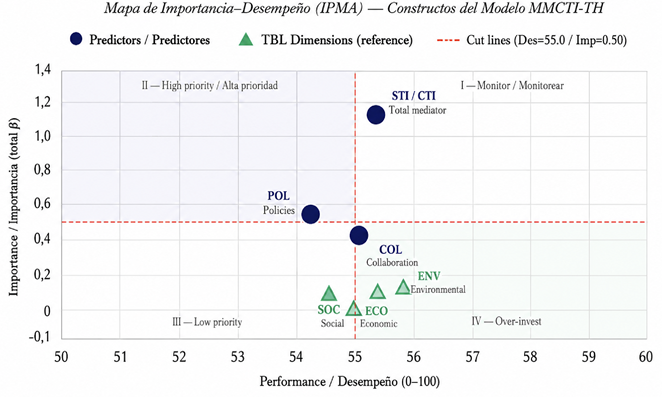
Figure 1: IPMA quadrant chart. X-axis = Performance (50-60/100). Y-axis = Importance (total β on TBL). STI in upper-left quadrant (importance 1.129, performance 55.35) = maximum priority. POL in the same quadrant (0.543, 54.23). COL in middle zone (0.427, 55.07). Cut lines: Performance = 55.0, Importance = 0.50. TBL dimensions as reference points
Note. Importance = total standardized effect on Sustainability TBL (direct + indirect). Performance = (mean − 1)/4 × 100. None of the constructs exceeds 56% of its potential, which gives evidence of a generalized systemic improvement gap across the whole of the Medellin STI ecosystem
Latent profile analysis: two actor configurations
The LPA selected K = 2 classes on the criterion of minimum BIC (BIC = 167.2 vs. 266.5 for K = 3; AIC = 143.8 vs. 241.2 for K = 3). The two-class solution was robust across 200 random initializations. Entropy = 0.81, indicating adequate class separation. Mean posterior classification probabilities: Class 0 (Connected Innovators) = 0.89; Class 1 (Peripheral Skeptical Actors) = 0.87, confirming reliable class assignment. Table 4 presents the standardized means by class, while Figure 1 illustrates the pattern of the profile.
Table 4.
Standardized
Means by Class — LPA (K = 2, N = 188).
|
Profile |
n |
% |
z_POL |
z_COL |
z_STI |
z_ENT |
z_TBL |
|
Connected Innovaros |
78 |
41.5% |
+0.342 |
+0.294 |
+0.300 |
+0.373 |
+0.262 |
|
Peripheral Skeptical Actors |
110 |
58.5% |
−0.243 |
−0.209 |
−0.213 |
−0.264 |
−0.186 |
|
Δz (Class 0 − Class 1) |
— |
— |
0.585 |
0.503 |
0.513 |
0.637 |
0.448 |
Note. z-scores relative to the global ecosystem meaning (N = 188). Oz = class difference. The largest gap is the one found in Entrepreneurship (Δz = 0.637), which indicates that it is the most polarizing construct within the ecosystem. The incentives for innovation entrepreneurship reach, in disproportionate fashion, those actors that are already connected, with the result that the existing asymmetry is amplified rather than reduced.
Figure 2 below presents the profiles of the actors of the Medellin STI ecosystem:
Figure 2.
Ecosystem
Actor Profiles — z-scores by dimension (K=2, LPA, N=188).
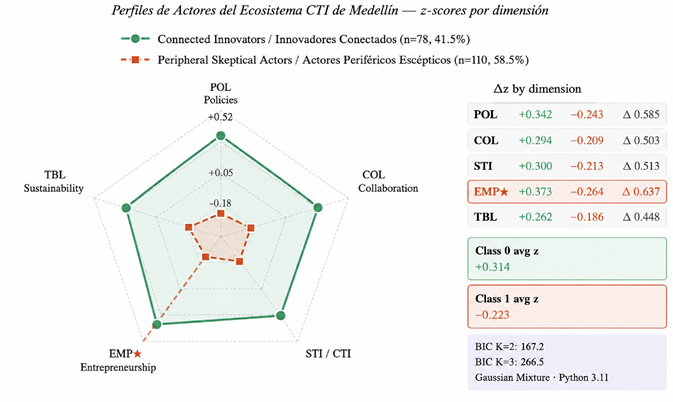
Figure 2: Radar chart with five dimensions (POL, COL, STI, ENT, TBL). Solid green line = Connected Innovators (avg z +0.30). Dashed red line = Peripheral Skeptical Actors (avg z −0.22). Largest gap in ENT (Entrepreneurship, Δz = 0.63). The skeptical polygon is uniformly interior to the connected polygon across all dimensions.
Note. The pattern of uniform suppression that the skeptical profile displays, in which no single dimension fails more than the others, constitutes the statistical signature of the systemic legitimacy deficit, that is, a generalized disconnection from the ecosystem rather than a specific resistance to anyone’s constructs.
The profile of the Peripheral Skeptical Actor neither rejects innovation nor lacks knowledge of the relevant regulations. What characterizes it is a pattern of uniform systemic disconnection, and not one of specific resistance. It is a distinction that bears upon the design of policy, for the disconnected actors do not need to be persuaded of the value of innovation; what they need are access points that have yet not been built.
The MMSTI-TH Model: Propositions and Research Product
The MMSTI-TH brings together the seven sets of results within a causal architecture that specifies how the Triple Helix generates business sustainability, under what conditions it does so, and with what variations according to the type of actor. This model is the core product of the present research, that is, a theoretical proposal, statistically validated, that proves at once citable, transparent, and replicable in other Latin American STI ecosystems.
The four empirical propositions
P1. Complete STI mediation: STI is the total mediator between institutional conditions and Sustainability TBL. Without active STI, governance policies and collaboration produce an effect statistically indistinguishable from zero. This proposition is empirically confirmed and is the most robust finding of the model.
P2. Sectoral differentiation of mechanisms: the model operates with different intensities and levers across actor types. University sector: Policies lead activation (β = 0.598***). Market sector: the mediated pathway coexists with direct coercive isomorphism (β = 0.321**). Institutional sector: Collaboration dominates with the highest coefficient in the model (β = 0.664***). Status: exploratory hypothesis pending replication with larger n.
P3. Systemic legitimacy deficit: 58.5% of the ecosystem holds perceptions consistently below average across all model dimensions. This deficit requires differentiated activation strategies for peripheral actors — not more sophisticated instruments, but lower-threshold intermediaries.
P4. STI as the strategic priority lever: the IPMA confirms STI as the highest-return intervention (total β = 1.129, performance 55.35/100). Investing in STI yields the highest sustainability return, but only when implemented alongside the simultaneous strengthening of the governance conditions that enable it.
Differentiated intervention pathways
Table 5.
Differentiated
Intervention Pathways by Actor Profile — MMSTI-TH Model.
|
Dimension |
Connected Innovators (41.5%) |
Peripheral Skeptical Actors (58.5%) |
|
Policy |
Co-design of regulatory instruments. Participation as expert validators in technical working groups. International benchmarking. |
Access simplification. Single-window systems with plain-language guidance. Law 2234/2022 as entry point into the formal ecosystem. |
|
STI |
High-risk R&D. Industry doctorate programs. University spin-offs (Presidencia de la República de Colombia, 2022). |
Applied STI. Nearby success cases. Tangible results within 6 to 12 months. |
|
Collaboration |
Network scaling. Open-innovation platforms. Formalization of existing alliances. |
Low-threshold first contact. Peer-to-peer matchmaking. Mentoring within the same sector. |
|
Sustainability |
Verified reporting (GRI, SDGs). Circular economy. BIC corporate model. |
Accessible sustainability: visible operational savings, TBL frameworks adapted to SMEs. |
|
Key indicator |
Scaled R&D projects with documented ecosystem impact. |
Reduction in the percentage of skeptical actors: measured Class 1 → Class 0 migration. |
Note. Class 0 (Connected Innovators) pathways scale existing capabilities. Class 1 (Peripheral Skeptical Actors) pathways activate and build first contact. The systemic indicator that matters most is the measurable migration of actors from Class 1 to Class 0, one that can be monitored through periodic applications of the MMSTI-TH instrument.
General Mediation Theory of Innovation Systems (GMTIS)
The results make it possible to raise the MMCTI-TH from an empirical model specific to Medellin to a theoretical framework of a generalizable kind, namely the General Mediation Theory of Innovation Systems (GMTIS). What this theory proposes is that the sustainable performance of a Triple Helix ecosystem is determined neither by the robustness of its policies nor by the intensity of its collaboration, but rather by the capacity of the STI mechanism to transform those conditions into sustainability outcomes that remain accessible to the whole of its actors.
Five theoretical propositions
P1. Necessary total mediation: in any Triple Helix system whatever, STI functions as the necessary total mediator that stands between the institutional conditions of governance and the sustainability outcomes. Governance structures that lack an active STI produce sustainability effects that are statistically indistinguishable from zero.
P2. Activation failure as the binding constraint: when the STI capacity of the ecosystem proves insufficient, or inaccessible to the majority of the actors, the system enters activation failure, and in that state the investment in governance instruments comes to yield diminishing returns on sustainability.
P3. Systemic legitimacy deficit as the failure indicator: the proportion of actors whose perceptions remain consistently below the average across all the dimensions of the institutional model constitutes the most direct indicator of the systemic legitimacy deficit, one measurable by way of the MMSTI-TH instrument.
P4. Multi-mechanism institutional logic: Triple Helix systems operate through three activation mechanisms that are simultaneous and at the same time differentiated, namely coercive isomorphism in the case of market actors, policy incentive in that of university actors, and collaborative co-production in that of institutional actors. Policy instruments of a uniform kind systematically under-serve at least two of the three mechanisms.
P5. Marginal STI amplification: in those systems where STI operates below its potential (performance < 60/100 on the IPMA scale), marginal improvements come to produce disproportionate returns on sustainability (β > 1), and, as the system matures and the performance of STI increases, the amplifier coefficient converges toward 1.
Conditions of application
The GMTIS applies under four conditions: (1) the innovation system must have the three Triple Helix actors formally articulated, even if asymmetrically; (2) some degree of enabling regulatory framework for STI must exist; (3) the sample must include actors from at least two of the three institutional sectors; and (4) the outcome variable must be some measure of business sustainability along any of the three TBL dimensions. These conditions are compatible with the vast majority of emerging innovation ecosystems in Latin America, sub-Saharan Africa, and South and Southeast Asia.
External validity: international comparison
Table 6 systematizes the comparison of activation failure conditions across five innovation systems. The reference cases reveal the maturity gradient that determines the magnitude of the failure.
Table 6.
International Comparison: Activation Failure Conditions Across Triple Helix
Innovation Systems.
|
System |
R+D/GDP |
Intermediaries STI |
Equitable access |
Activation failure |
Implication for GMTIS |
|
Finland/Sweden |
> 3.0% |
High density |
Structural |
Low |
Mature systems: intermediaries eliminate the skeptical periphery. β STI→TBL → 1. |
|
South Korea |
4.8% |
High density |
Progressive |
Low-medium |
Sustained investment in reducing access barriers. Reference for staged activation. |
|
China |
2.4% |
Medium density |
Asymmetric |
Medium |
Explicitly designed differentiated mechanisms by actor type. Consistent with P4. |
|
Brazil |
1.2% |
Medium density |
Partial |
Medium-high |
Connected and peripheral actors coexist. Systemic deficit not yet quantified. |
|
Colombia (Medellin) |
0.2% |
Low density |
Asymmetric |
HIGH (58.5%) |
Systemic legitimacy deficit quantified. Amplifier β = 1.129. Central empirical case. |
Note. Research and Development (R&D)/ Gross Domestic Product (GDP): OECD/World Bank data 2022-2023. Exact quantification of activation failure through the MMCTI-TH instrument is only available for the Medellin case. Comparison with other systems is necessarily approximate and constitutes the proposed future research agenda.
The GMTIS framework
Figure 3.
General
Mediation Theory of Innovation Systems (GMTIS) — MMSTI-TH Theoretical
Framework.
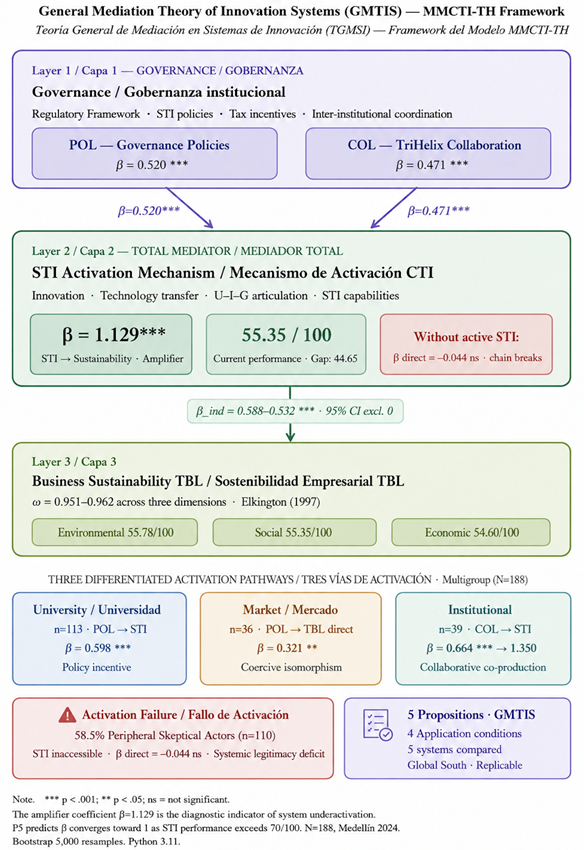
Figure 3: Three-layer diagram. Layer 1 (purple): Governance — POL (β=0.520***) and COL (β=0.471***). Arrows to Layer 2 (jade green): STI Activation — total mediator β=1.129***, performance 55.35/100. Arrow to Layer 3 (light green): Sustainability TBL — Environmental 55.78, Social 55.35, Economic 54.60. Below: three differentiated activation pathways (blue=University incentive, amber=Market coercive, green=Institutional collaborative). Lower left: Activation Failure zone (red), 58.5% peripheral, β_direct = -0.044 ns. Right panel: 5 Propositions · 4 Application Conditions · Documented External Validity
Note. The amplifier coefficient β=1.129 is the diagnostic indicator of the system’s underactivation state. P5 predicts that β converges toward 1 when STI performance exceeds 70/100. The activation failure zone describes ecosystems where the STI layer is inaccessible to the majority of actors.
4. DISCUSSION
Contribution to the Triple Helix literature: when and why the Triple Helix fails
The Triple Helix does not fail when institutions are weak. It fails when institutions are formally adequate but the mechanism that should connect them to their intended beneficiaries operates below its activation threshold — or is inaccessible to the majority of actors. That distinction changes the nature of the diagnosis.
The most specific contribution of the MMCTI-TH to the literature is the evidence of complete STI mediation in an emerging economic context. Existing studies document correlations between Triple Helix relationships and innovation (Etzkowitz & Leydesdorff, 1998; Leydesdorff, 2011), but they rarely establish the necessity of the mediating mechanism. The finding β_direct = −0.044 (ns) in the presence of the STI mediator is the clearest available evidence in the Latin American literature that governance without active STI does not produce sustainability.
The application of LPA to the study of STI ecosystem actors is a methodological innovation in the Latin American Triple Helix literature. Previous studies categorize actors by institutional sector (university, firm, government) or by functional role. LPA allows for an empirically grounded segmentation without predefined categories, generating typologies with higher predictive value for intervention design. The Peripheral Skeptical Actor profile — the ecosystem majority — has no equivalent in the existing literature as a quantified analytical category.
Systemic legitimacy deficit: a new theoretical concept
This study introduces the systemic legitimacy deficit as a new analytical concept for the Triple Helix literature. Suchman (1995) draws a distinction among pragmatic, moral, and cognitive legitimacy in organizations, and argues that the absence of legitimacy is not a passive state but rather an active configuration of institutional disconnection.
What the LPA documents in the case of Medellin is a specific form of cognitive legitimacy deficit, that of actors who coexist with the formal ecosystem without recognizing it as their own or as something useful for their own objectives.
That category proves more precise than the general notion of innovation gaps (Arocena & Sutz, 2010), and it does so because it is empirically quantifiable, because it is dimensionally specific, being larger in Entrepreneurship than in Sustainability, and because it is linked directly to differentiated activation pathways.
The limits of public policy and empirical contradictions
The literature on the entrepreneurial state (Mazzucato, 2018) has argued, and argued persuasively, that the state can and ought to lead STI investment as a condition for economic transformation. What the MMCTI-TH adds to that argument is a critical specification, namely that the leadership of the state in STI yields sustainability returns only when the transmission mechanism remains active for the full set of the ecosystem’s actors, and not solely for those that are most institutionally connected.
Public investment in STI that reaches exclusively the 41.5% of Connected Innovators reproduces systemic inequality rather than reducing it. The OECD (2022) has argued that the evaluation of policy ought to answer what works, why, for whom, and under what circumstances; and the question of for whom it does not work, that is, the 58.5% that make up the periphery, turns out to be the most actionable finding of all.
There is, moreover, an empirical contradiction that deserves to be recognized in explicit terms: the multigroup data show that in the case of the Market sector there exists a direct Policies→Sustainability path (β = 0.321, p =.020) which does not require the mediation of STI.
That finding, consistent with coercive-mimetic isomorphism (DiMaggio & Powell, 1983), suggests that direct regulation may be more effective for peripheral actors with lower institutional maturity. The policy implication is counterintuitive: more regulation, not more innovation incentives, may be the appropriate strategy for that segment.
Limitations and future research agenda
Three limitations warrant explicit acknowledgment. First, the cross-sectional design does not permit verification of the temporal sequence between variables; causal relationships have the status of structural consistency with the theoretical model, not experimental causation. Second, the sample concentration in the university sector (60.1%, n = 113) limits representativeness and statistical power for the Market (n = 36) and Institutional (n = 39) sector subgroups; all sectoral patterns are exploratory pending replication.
The sample concentration in the university sector (60.1%) limits statistical power for the Market sector multigroup analysis (n = 36), where the direct path retains exploratory status. Systemic legitimacy deficit emerges as an interpretive category from the LPA but was not operationalized as a directly measured latent variable; its validation through external constructs constitutes a direction for future research.
These limitations define three productive research directions: (1) a two-wave longitudinal design to verify the temporal sequence of the mediation mechanism; (2) cross-national comparisons applying the MMCTI-TH in Latin American cities with varying levels of Triple Helix maturity, to determine whether systemic legitimacy deficit is specific to Medellin or is a structural feature of peripheral STI ecosystems; and (3) the operationalization of systemic legitimacy deficit as a latent variable through Suchman’s (1995) typology for its inclusion in comparative structural models.
5. CONCLUSIONS
This study began with a concrete question and arrived at an equally concrete answer. The evidence from this study indicates that the Triple Helix is associated with business sustainability outcomes in Medellin primarily through the activation of STI as a transformative mechanism. Without that activation, governance policies and inter-institutional collaboration produce an effect on sustainability that is not statistically distinguishable from zero within the model, a finding bounded by the cross-sectional, non-probabilistic design employed. That is the central finding of the MMSTI-TH, and it is also its most directly actionable contribution to those who design and implement STI policy in the Colombian innovation ecosystem.
The most direct implication for public policy is that the central assumption of Colombian STI policies, that better governance directly generates sustainability, does not find no empirical support in the model estimated here, a conclusion that must be qualified by the cross-sectional design’s inability to establish temporal sequence or causality. The mechanism is indirect and requires active STI as a necessary condition. Medellin has institutional architecture and university capabilities to activate that mechanism at a greater scale. What is still needed is for that activation to reach 58.5% that is waiting to be effectively included in the city’s STI ecosystem. Building the low-threshold intermediaries that bridge that gap does not require new legislation. It requires redesigning the implementation mechanisms of instruments that already exist.
Finally, the MMSTI-TH offers replicable instruments whose external validity requires verification through longitudinal studies, cross-national comparisons, and independent samples. Its 71-item instrument, its seven-technique convergent methodology, its differentiated intervention pathways, and the GMTIS framework can be applied to STI ecosystems in Latin America, Africa, and Asia with structurally similar conditions. Cross-city comparisons would make it possible to determine whether systemic legitimacy deficit is a characteristic of Medellin or a structural feature of peripheral STI ecosystems that the Triple Helix model, in its current formulation, has not yet resolved. It must be noted that the cross-sectional design employed does not permit establishing temporal sequence or causality; the structural relationships reported reflect consistency with the proposed theoretical model, not experimental causal demonstration.
References
Arocena, R., & Sutz, J. (2010). Weak knowledge demand in the South: Learning divides and innovation policies. Science and Public Policy, 37(8), 571–582. https://doi.org/10.3152/030234210X12767691861137
Baron, R. M., & Kenny, D. A. (1986). The moderator-mediator variable distinction in social psychological research: Conceptual, strategic, and statistical considerations. Journal of Personality and Social Psychology, 51(6), 1173–1182. https://doi.org/10.1037/0022-3514.51.6.1173
Bhaskar, R. (1979). The possibility of naturalism: A philosophical critique of the contemporary human sciences. Harvester Press.
Carayannis, E. G., & Campbell, D. F. J. (2009). “Mode 3” and “Quadruple Helix”: Toward a 21st century fractal innovation ecosystem. International Journal of Technology Management, 46(3), 201-234. https://doi.org/10.1504/IJTM.2009.023374
Congreso de Colombia. (2014). Ley 1715 of 2014. [Official Gazette No. 49150]. https://www.funcionpublica.gov.co/eva/gestornormativo/norma.php?i=57353
Congreso de Colombia. (2018). Ley 1901 of 2018. [Official Gazette No. 50.628]. https://www.funcionpublica.gov.co/eva/gestornormativo/norma.php?i=86982
Congreso de Colombia. (2019). Ley 1951 de 2019 - Creation of the Ministry of Science, Technology, and Innovation; strengthening of the national science, technology, and innovation system. [Official Gazette No. 50.846]. https://www.funcionpublica.gov.co/eva/gestornormativo/norma.php?i=90308
Congreso de Colombia. (2021). Ley 2169 de 2021. [Official Gazette No. 51.896]. http://www.secretariasenado.gov.co/senado/basedoc/ley_2169_2021.html
Congreso de Colombia. (2022). Ley 2234 de 2022. [Official Gazette No. 52.089]. https://www.funcionpublica.gov.co/eva/gestornormativo/norma.php?i=189388
Creswell, J. W., & Creswell, J. D. (2018). Research design: Qualitative, quantitative, and mixed methods approaches (5th ed.). SAGE.
DeVellis, R. F. (2016). Scale development: Theory and applications (4th ed.). SAGE.
DiMaggio, P. J., & Powell, W. W. (1983). The iron cage revisited: Institutional isomorphism and collective rationality in organizational fields. American Sociological Review, 48(2), 147-160. https://doi.org/10.2307/2095101
Dutrénit, G., & Sutz, J. (Eds.). (2014). National innovation systems, social inclusion and development: The Latin American experience. Edward Elgar. https://doi.org/10.4337/9781782548683
Elkington, J. (1997). Cannibals with forks: The triple bottom line of 21st century business. Capstone.
Etzkowitz, H., & Leydesdorff, L. (1998). The Endless Transition : A “Triple Helix” of University-Industry-Government relations: Introduction. Minerva, 36(3), 203-208. http://www.jstor.org/stable/41821107
Etzkowitz, H., & Leydesdorff, L. (2025). Innovation and the Triple Helix. Scientometrics, 130, 3279-3291. https://doi.org/10.1007/s11192-025-05337-8
Geels, F. W. (2004). From sectoral systems of innovation to socio-technical systems: Insights about dynamics and change from sociology and institutional theory. Research Policy, 33(6–7), 897–920. https://doi.org/10.1016/j.respol.2004.01.015
Khanna, T., & Palepu, K. G. (1997). Why focused strategies may be wrong for emerging markets. Harvard Business Review, 75(4), 41-51. https://hbr.org/1997/07/why-focused-strategies-may-be-wrong-for-emerging-markets
Kline, R. B. (2023). Principles and practice of structural equation modeling (5th ed.). Guilford Press.
Leydesdorff, L. (2011). The Triple Helix, Quadruple Helix, ..., and an N-tuple of helices: Explanatory models for analyzing the knowledge-based economy? Journal of the Knowledge Economy, 3(1), 25–35. https://doi.org/10.1007/s13132-011-0049-4
MacKinnon, D. P. (2008). Introduction to statistical mediation analysis. Routledge. https://doi.org/10.4324/9780203809556
Mazzucato, M. (2018). The entrepreneurial state: Debunking public vs. private sector myths (Rev ed.). Penguin.
McDonald, R. P. (1999). Test theory: A unified treatment. Lawrence Erlbaum.
Ministerio de Ciencia, Tecnología e Innovación (Minciencias). (2016). Invierte en I+D+i y accede a beneficios tributarios. https://www.minciencias.gov.co/sala_de_prensa/invierte-en-idi-y-accede-beneficios-tributarios
Nahapiet, J., & Ghoshal, S. (1998). Social capital, intellectual capital, and the organizational advantage. Academy of Management Review, 23(2), 242-266. https://doi.org/10.5465/amr.1998.533225
Organization for Economic Co-operation and Development (OECD). (2022). Recommendation of the Council on Public Policy Evaluation (OECD/LEGAL/0478). OECD. https://legalinstruments.oecd.org/en/instruments/OECD-LEGAL-0478
Podsakoff, P. M., MacKenzie, S. B., & Podsakoff, N. P. (2012). Sources of Method Bias in Social Science Research and Recommendations on How to Control It. Annual Review of Psychology, 63, 539–569. https://doi.org/10.1146/annurev-psych-120710-100452
Presidencia de la República de Colombia. (2022). Decreto 1556 de 2022. [Official Gazette No. 52.117]. https://www.funcionpublica.gov.co/eva/gestornormativo/norma.php?i=191926
Sábato, J., & Botana, N. (1970). La ciencia y la tecnología en el desarrollo futuro de América Latina. Instituto de Estudios Peruanos. https://hdl.handle.net/20.500.14660/1037
Suchman, M. C. (1995). Managing legitimacy: Strategic and institutional approaches. Academy of Management Review, 20(3), 571–610. https://doi.org/10.2307/258788
Teece, D. J., Pisano, G., & Shuen, A. (1998). Dynamic capabilities and strategic management. Strategic Management Journal, 18(7), 509–533. https://doi.org/10.1002/(SICI)1097-0266(199708)18:7%3C509::AID-SMJ882%3E3.0.CO;2-Z
Weber, K. M., & Rohracher, H. (2012). Legitimizing research, technology and innovation policies for transformative change: Combining insights from innovation systems and multi-level perspective in a comprehensive ‘failures’ framework. Research Policy, 41(6), 1037–1047. https://doi.org/10.1016/j.respol.2011.10.015
References
- Arocena, R., & Sutz, J. (2010). Weak knowledge demand in the South: Learning divides and innovation policies. Science and Public Policy, 37(8), 571–582. https://doi.org/10.3152/030234210X12767691861137
- Baron, R. M., & Kenny, D. A. (1986). The moderator-mediator variable distinction in social psychological research: Conceptual, strategic, and statistical considerations. Journal of Personality and Social Psychology, 51(6), 1173–1182. https://doi.org/10.1037/0022-3514.51.6.1173
- Bhaskar, R. (1979). The possibility of naturalism: A philosophical critique of the contemporary human sciences. Harvester Press.
- Carayannis, E. G., & Campbell, D. F. J. (2009). “Mode 3” and “Quadruple Helix”: Toward a 21st century fractal innovation ecosystem. International Journal of Technology Management, 46(3), 201-234. https://doi.org/10.1504/IJTM.2009.023374
- Congreso de Colombia. (2014). Ley 1715 of 2014. [Official Gazette No. 49150]. https://www.funcionpublica.gov.co/eva/gestornormativo/norma.php?i=57353
- Congreso de Colombia. (2018). Ley 1901 of 2018. [Official Gazette No. 50.628]. https://www.funcionpublica.gov.co/eva/gestornormativo/norma.php?i=86982
- Congreso de Colombia. (2019). Ley 1951 de 2019 - Creation of the Ministry of Science, Technology, and Innovation; strengthening of the national science, technology, and innovation system. [Official Gazette No. 50.846]. https://www.funcionpublica.gov.co/eva/gestornormativo/norma.php?i=90308
- Congreso de Colombia. (2021). Ley 2169 de 2021. [Official Gazette No. 51.896]. http://www.secretariasenado.gov.co/senado/basedoc/ley_2169_2021.html
- Congreso de Colombia. (2022). Ley 2234 de 2022. [Official Gazette No. 52.089]. https://www.funcionpublica.gov.co/eva/gestornormativo/norma.php?i=189388
- Creswell, J. W., & Creswell, J. D. (2018). Research design: Qualitative, quantitative, and mixed methods approaches (5th ed.). SAGE.
- DeVellis, R. F. (2016). Scale development: Theory and applications (4th ed.). SAGE.
- DiMaggio, P. J., & Powell, W. W. (1983). The iron cage revisited: Institutional isomorphism and collective rationality in organizational fields. American Sociological Review, 48(2), 147-160. https://doi.org/10.2307/2095101
- Dutrénit, G., & Sutz, J. (Eds.). (2014). National innovation systems, social inclusion and development: The Latin American experience. Edward Elgar. https://doi.org/10.4337/9781782548683
- Elkington, J. (1997). Cannibals with forks: The triple bottom line of 21st century business. Capstone.
- Etzkowitz, H., & Leydesdorff, L. (1998). The Endless Transition : A “Triple Helix” of University-Industry-Government relations: Introduction. Minerva, 36(3), 203-208. http://www.jstor.org/stable/41821107
- Etzkowitz, H., & Leydesdorff, L. (2025). Innovation and the Triple Helix. Scientometrics, 130, 3279-3291. https://doi.org/10.1007/s11192-025-05337-8
- Geels, F. W. (2004). From sectoral systems of innovation to socio-technical systems: Insights about dynamics and change from sociology and institutional theory. Research Policy, 33(6–7), 897–920. https://doi.org/10.1016/j.respol.2004.01.015
- Khanna, T., & Palepu, K. G. (1997). Why focused strategies may be wrong for emerging markets. Harvard Business Review, 75(4), 41-51. https://hbr.org/1997/07/why-focused-strategies-may-be-wrong-for-emerging-markets
- Kline, R. B. (2023). Principles and practice of structural equation modeling (5th ed.). Guilford Press.
- Leydesdorff, L. (2011). The Triple Helix, Quadruple Helix, ..., and an N-tuple of helices: Explanatory models for analyzing the knowledge-based economy? Journal of the Knowledge Economy, 3(1), 25–35. https://doi.org/10.1007/s13132-011-0049-4
- MacKinnon, D. P. (2008). Introduction to statistical mediation analysis. Routledge. https://doi.org/10.4324/9780203809556
- Mazzucato, M. (2018). The entrepreneurial state: Debunking public vs. private sector myths (Rev ed.). Penguin.
- McDonald, R. P. (1999). Test theory: A unified treatment. Lawrence Erlbaum.
- Ministerio de Ciencia, Tecnología e Innovación (Minciencias). (2016). Invierte en I+D+i y accede a beneficios tributarios. https://www.minciencias.gov.co/sala_de_prensa/invierte-en-idi-y-accede-beneficios-tributarios
- Nahapiet, J., & Ghoshal, S. (1998). Social capital, intellectual capital, and the organizational advantage. Academy of Management Review, 23(2), 242-266. https://doi.org/10.5465/amr.1998.533225
- Organization for Economic Co-operation and Development (OECD). (2022). Recommendation of the Council on Public Policy Evaluation (OECD/LEGAL/0478). OECD. https://legalinstruments.oecd.org/en/instruments/OECD-LEGAL-0478
- Podsakoff, P. M., MacKenzie, S. B., & Podsakoff, N. P. (2012). Sources of Method Bias in Social Science Research and Recommendations on How to Control It. Annual Review of Psychology, 63, 539–569. https://doi.org/10.1146/annurev-psych-120710-100452
- Presidencia de la República de Colombia. (2022). Decreto 1556 de 2022. [Official Gazette No. 52.117]. https://www.funcionpublica.gov.co/eva/gestornormativo/norma.php?i=191926
- Sábato, J., & Botana, N. (1970). La ciencia y la tecnología en el desarrollo futuro de América Latina. Instituto de Estudios Peruanos. https://hdl.handle.net/20.500.14660/1037
- Suchman, M. C. (1995). Managing legitimacy: Strategic and institutional approaches. Academy of Management Review, 20(3), 571–610. https://doi.org/10.2307/258788
- Teece, D. J., Pisano, G., & Shuen, A. (1998). Dynamic capabilities and strategic management. Strategic Management Journal, 18(7), 509–533. https://doi.org/10.1002/(SICI)1097-0266(199708)18:7%3C509::AID-SMJ882%3E3.0.CO;2-Z
- Weber, K. M., & Rohracher, H. (2012). Legitimizing research, technology and innovation policies for transformative change: Combining insights from innovation systems and multi-level perspective in a comprehensive ‘failures’ framework. Research Policy, 41(6), 1037–1047. https://doi.org/10.1016/j.respol.2011.10.015
Article information
License and rights
Copyright (c) 2026 Unaciencia, Revista de Estudios e Investigaciones

This work is licensed under a Creative Commons Attribution-NonCommercial-NoDerivatives 4.0 International License.
- Section
- Research article